

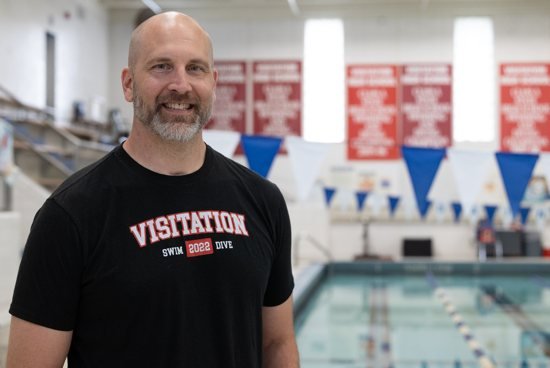


The award recognizes the powerhouse team he has built at all-girls Vis, where the swimming and diving team has won 13 state Class A championships, including the last nine. Linscheid also teaches physics at Jefferson High School in Bloomington.
“I’m super thankful,” said Linscheid, 51, an Apple Valley father of two whose wife, Julie, is the diving coach and a counselor at Vis.
Q) Your firstborn just started college. Are you asking yourself if you did everything you could to prepare him for the real world?
A) You always second-guess decisions you made, but I try to think of it as: I did the best I could. You have to trust they will make mistakes, but they’ll be fine.
Q) What did you get right?
A) We put him in swimming when he was young — like 7 years old — and within a few years, he was just not having it, so we decided to completely back off. We’re not going to force it. And then, right before junior year in high school, he decided to join the swim team. (The decision) was owned by him — we never pushed. Now he’s going to (University of Minnesota) Morris, where they’re starting a men’s team, and he’s going to be on that.
I’ve coached a number of kids over the past 30 years who you can tell that their parents are making them be there. Some are talented, some are less so — but it doesn’t matter. It was a miserable experience for everybody involved.
Q) You don’t have to start a sport at age 3 and play year-round to excel at it later.
A) Oh, I know. When people say, “It’s too late to start a sport if you didn’t begin at a very young age,” I ask, “It’s too late for what?” They can play the sport. But are you talking about: Is it too late for them to be a D-1 athlete? They either were going to be or weren’t going to be. You can’t force that. People get so wrapped up with status.
It’s good to leave room for creativity. If kids are constantly in a structured program, being told, “Do it this way,” they don’t get to try stuff out, do new things and fail without consequence.
Q) What’s the secret to your swim team’s success?
A) We have really good swimmers who want to swim on our team. They are such a cohesive family unit that it’s a place where they want to be the best that they can be. Everybody encourages each other — whether they’re the best swimmer on the team or someone who is just starting out. There’s a spot for everyone there. It’s a place where they feel loved and supported by each other.
Q) Are girls coming to Vis because they want to swim?
A) I’ve heard girls say, “Well, I want to swim, so Vis is where I want to go.” Our Catholic Athletic Association program, which is a feeder, has blown up. There are girls in younger grades who say their goal is to be on the Vis high school swim team.
Q) Were all your state championships big wins?
A) No, there were a couple close years against Hutchinson. We had one year where we won by around 10 points. Had anybody false started or anything bad happened at the meet, we would’ve lost points.
The last few years, we’ve won by more points. Last year we almost doubled up: We had 399, and the next score was around 200.
Q) Are you a strong contender to win your 10th consecutive championship this school year?
A) We have a lot of really fast girls who are coming back. I have every reason to believe that, as long as we can stay healthy and continue to work hard and have fun and compete hard, we should be in a good position again.
Q) What have you learned about leadership?
A) One is serving the people that you lead, and the other one is setting a good example. You’re not there just to yell at people and be the boss. They’ll follow you if you serve and lead.
My experience at Vis has been unique in a sense where the leadership has been so good that there’s almost a snowball effect — from girls who are officially the captains and from those who are not. We have captains who are juniors and seniors. The juniors learn what to do their junior year and then they’re the senior captains the next year and there’s this continuity. They saw great examples and they want to continue that.
I’ve seen it from other teams, where athletes want to obtain that rank of captain to put on the resume because it’s the top of the achievement hill. It’s like, “Well, no, that is your license now to turn it back to everybody that you’re the captain of, serving those people and showing the way. It’s a job.”
Q) You’re a physics teacher. Do you apply that knowledge to swimming?
A) Definitely! I’ll talk about the forces involved as you’re moving your hand through the water. I’ll bring up something about Newton’s Laws, which usually gets a few chuckles.
But for me, that’s a way I consume the knowledge, and as far as how to do things, then I have to translate that.
Q) What do you love about swimming?
A) I swam in the ’80s and early ’90s, and we didn’t have the internet and we didn’t have phones. If you wanted to know something, we had to go to the library and find an encyclopedia. Everything took more time, and now you can get everything you want whenever you want it. Swimming is a throwback because it won’t work that way. You have to put in the time and effort over a long period of time. You have to slow down and take a longer view. That may be the only two hours of a day where someone gets that now.
Q) Do you try to incorporate Salesian Spirituality, the virtues of the Visitation order?
A) Not outright, but last year’s theme was gratitude, and this year is humility, and we talk about those things regularly.
Q) I bet you witness joyful optimism, too.
A) We’re doing hard workouts, and in between, the girls are laughing. Some of them are just super positive human beings, and that spreads.
Q) What does swimming teach about life?
A) If you work hard, you’ll get better. And you can extrapolate that to other areas of life. I learned to play guitar 13 years ago — pretty much self-taught. It had been in my head for 30 years, and I decided, “I’m just going to do it.” So, I bought a guitar and watched lessons on Apple’s GarageBand. There were times when I could not do a C chord, but I practiced a little every day, and suddenly, within three weeks, it was totally natural. When my sons were really young, I played a lot of Johnny Cash.
The process of learning is the thing that I like to do.
Q) What do you know for sure?
A) I know for sure that I have a great family and I’m supported, and I’ve had that my entire life, which makes me very fortunate. There are a lot of people who don’t get that same support. My hope, for my athletes, is that they know for sure that somebody cares about them and that they’re important. That’s what everybody wants: to feel like they’re important.

