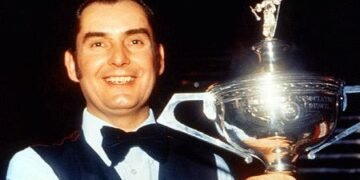


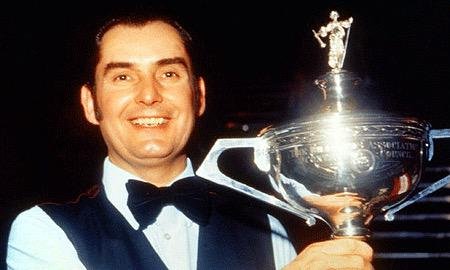
There is a sense of sadness and reflection within snooker this weekend following the passing of Ray Reardon on Friday at the age of 91.
The proud Welshman lived a long and successful life that should be celebrated rather than mourned, however.
Born in 1932, Reardon was a man of many careers. First and foremost, he was a wonderful snooker player.
But before that, he was also a coal miner who evaded death in his 20s after a collapsed mine left him trapped underground for several hours. He was later also a policeman.
Snooker was his primary passion of course – a game he had played since being introduced to it by his uncle as a young boy.
A pioneer of modernising the sport into what we know today, Reardon was professional snooker’s first dominant force.
Let’s, then, remember just a few of his finest snooker achievements.
Pot Black
Reardon was a six-time Welsh amateur champion and a former English amateur champion by the time he turned professional in 1967.
At that time, snooker was a mangled mess of affairs with hardly any professional players, a lack of proper tournaments, and not even a ranking system in place.
Reardon was later at the forefront of the battle with authorities to change the game for the better and improve its standards.
One tournament that completely transformed snooker’s image with the public was Pot Black.
The single-frame event was aired on BBC just at a time when colour television was coming into prominence across the United Kingdom.
It introduced players like Reardon, John Spencer, John Pulman, and Fred Davis to a wider audience who became infatuated with their craft and character.
Reardon won the inaugural Pot Black in 1969, a victory that spearheaded the success he’d enjoy in the following decade.
World Snooker Championship
The 1990s period was dominated by Stephen Hendry and the decade before that was controlled by Steve Davis.
Yet before those two, Ray Reardon was the first governor of the game who relentlessly reigned throughout the 1970s.
In 1970, Reardon beat Pulman 37-33 to claim the world title for the first time and subsequently added four more on the bounce between 1973 and 1976.
By this point, the sport was growing but was still being held back by mismanagement, lacklustre promotion, and a constant shift of venues for its blue-riband tournament.

That all began to change in 1977 when the Crucible Theatre in Sheffield hosted the World Snooker Championship for the first time.
By now, Reardon was well into his 40s and there were plenty of eager young stars who were soon set to enter the fold.
In 1978, it all came together one last time for Reardon and thankfully at the Crucible, where he overcame Perrie Mans to etch his name onto the trophy for a sixth time.
World number one
A limited ranking system for snooker was introduced in the mid-1970s as the sport continued its attempt to legitimise its standards.
Only one tournament counted, however, with results from the previous three World Championships used to determine the order.
As the word champion in 1973, 1974 and 1975, Reardon naturally became the first world number one when the rankings system was launched ahead of the 1975/76 campaign.
But even though only a solitary tournament was utilised, Reardon was very much a deserving world number one.
Around this time, the Tredegar potter won several other prestigious titles including the Masters, the Champion of Champions, the Pontins Professional, and Pot Black again in 1978.
Reardon held top spot in the rankings from 1975 to 1981, and he regained the coveted position ahead of the 1982/83 snooker season.
Professional Players Tournament
Ray Reardon reached top spot in the rankings again off the back of his terrific performance at the 1982 World Championship, when he reached the final only to be denied glory for a seventh time by Alex Higgins.
Several months later he turned 50, making his achievement at the Professional Players Tournament even more outstanding.
For the first time that season, some events other than the World Championship were attributed with ranking event status.
Reardon lost in the last 16 of the first such tournament, suffering a 5-2 reverse to eventual International Open champion Tony Knowles in Derby.
Less than two weeks later, however, he beat the likes of Alex Higgins and Eddie Charlton en route to the final of the Professional Players Tournament.
In the title-deciding affair, Reardon faced a fresh face of the main tour called Jimmy White, who was three decades his junior.
Reardon won 10-5 with a high break of 132, and in doing so he became the oldest ranking event champion – a record that still stands today.
Coaching Ronnie O’Sullivan
Ray Reardon won a couple more notable tournaments after that and in 1985 he was awarded an MBE for his services to snooker.
By the late-1980s his game was in decline, and he eventually retired from professional snooker in 1991 after losing in that year’s World Championship qualifiers.
More than ten years on, Reardon received a phone call from Ronnie O’Sullivan Snr who felt that his son needed help mastering the tactical side of the game.
Reinvigorated with the motivation to nurture the sport’s brightest and most natural talent, Reardon jumped at the opportunity.
He was watching proudly from the sidelines as O’Sullivan romped to glory at the 2004 World Snooker Championship, where he demonstrated a lot of his newly acquired nous for safety play.
In his post-match celebrations, O’Sullivan donned mock vampire teeth in reference to Reardon’s renowned nickname as Dracula.
Reardon later admitted that coaching the Rocket added another ten years to his life.
And what a spectacular life it was.
Featured photo credit: WST

