

In swimming, and sport, much ado is made of honoring the fastest and most efficient performers.
But such focus can overshadow the doggedness, persistence, and perseverance it takes to do just the opposite.
On Wednesday this week, Sophie Etheridge set a new English Channel crossing record. Swimming for 29 hours and 4 minutes, she performed the slowest swim from England to France across the world’s most famous channel, pending ratification.
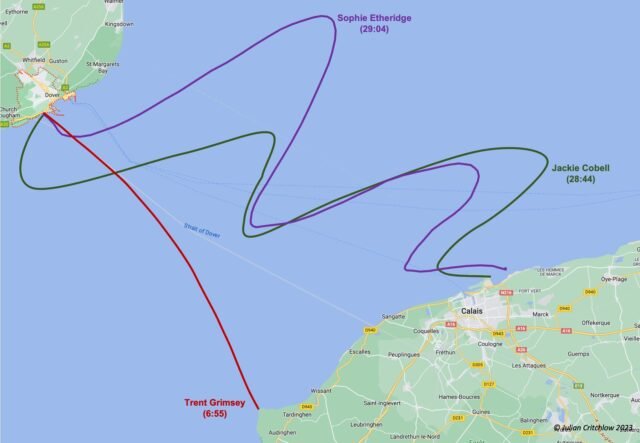
That swim was more than four times as long as Trent Grimsey’s fastest swim record of 6 hours, 55 minutes.
Etheridge posted this on Facebook after the swim:
I am utterly overwhelmed at the amount of support I have recieved. Thank you for every message of encouragement and congratulations – just think how much money I could raise to help make swimming more inclusive if everyone of you donated too (link below).
Throughout the swim my crew did more than they will know, obviously feeding was critical but their faith in me and encouragement got me through some really rough waters the second night when one of my biggest fears was having a boat land on top me and not about if I would land in France or not. To give you an idea, I managed to some how suddenly find myself facing the wrong way on the opposite side of the boat to where I had and i most definitely wasnt swimming back to England.
Realistically, I knew my very patient and skilled pilot, Lance Oram would pull me if it was getting too dangerous and it had its moments but after a chat about my issue and fear, we figured out the least daunting place for me to swim – following a circle of fairy lights we attatched to the back edge/railing all the way, eventually, to Calais!
Pending ratification myself and my crew just experienced the world’s longest one way English Channel Solo swim and being awake for that length of time takes its toll. For that reason, I ask that for the next few days to have the media please bare with us all, let us recover, process and heal. Channel Swimming can be brutal, so can be being on a small bobbing boat for 35+ hours!
If you want to share a message about my swim, spread my fundraising page and message. I swam for almost 30 hours, I’ve just reached £3000 to try and help improve access to swimming for those with disabilities with the STA STARLIGHT Campaign. Having the ability to learn to swim, no matter if you have a disability or not is a life skill. Not only that, if you have a disability, don’t ever let it limit you – you can do anything you put your mind to – it just might be done in a slightly different way to how someone else would do it!
Thank you
Sophie
Etheridge, 31, swam to raise awareness for a Swimming Teachers Association campaign for swimmers with disabilities.
Etheridge is a lifelong competitive swimmer and competed in triathlons until she was hit by a car in 2011. That left her in permanent pain with limited mobility, being reliant on a wheelchair for most of her movement on land. She has also been diagnosed with Fybromalgia, a complex and poorly-understood condition that causes pain throughout the body.
“Being in the water hurts, being thrown around by the waves hurts even more. You have huge ferries and tankers going past you and I have been learning how to swim controlling that level of pain – it’s as much mental as physical,” she said.
Etheridge was coached through the swim by Loretta Cox, who herself completed a channel swim in 1995 – in 15 hours, 37 minutes.
Etheridge departed from Dover in the England side before landing at the port in Calais, France more than a day later.
Longest Crossing
The history of the longest crossing, it turns out, is a fascinating one. As documented by channel swimming historian Julian Critchlow on Facebook, the previous longest crossing was a 28:44 done by Jackie Cobell in 2010. Before that, the record stood for almost 90 years – by Henry Sullivan, who was the 3rd person to cross the channel in 192 in 26:50.
The first three recorded channel crossing swims all set a new longest crossing record.
- Matthew Webb in 1875 – 21:45
- Thomas Burgess in 1911 – 22:35 (18th attempt)
- Henry Sullivan in 1923 – 26:50
After just three successful crossings in the first 50 years, the pace has picked up considerably – the sanctioning Channel Swimming Association recognizes 84 successful swims so far already in 2023.
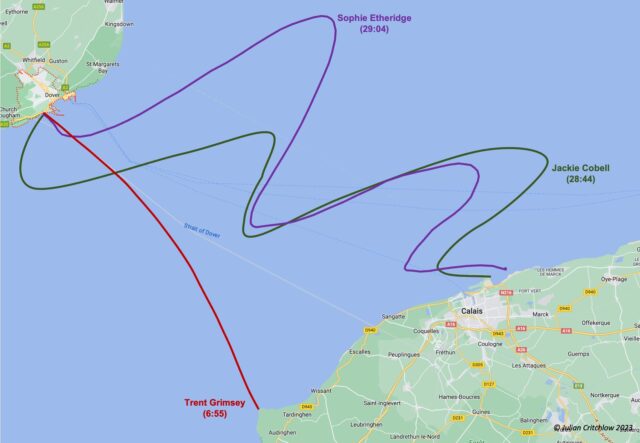
Critchlow elaborated on the mechanics of tides in the English Channel and why Ethridge’s swim took so long. The tides go up and down the channel in 6 hour cycles. That’s why Etheridge and Cobell’s swims took similar paths – see the chart below from Critchlow.

