

Looking to squeeze a little more horsepower from your freestyle pull? Here are seven tips for building a stronger, more powerful free pull.
A strong freestyle pull is crucial for helping you swim faster. Whether you are a distance swimmer, sprinter, or somewhere in the middle, a strong pull will help you move faster through the water.
According to multiple studies with experienced competitive swimmers, the pull contributes between 85-90% of overall swim speed (Deschodt et al., 1999; Gourgoulis et al, 2014).
Developing a strong, fast pull is a combination of excellent technique, swim-specific strength, and putting in the repetitions in practice.
In this guide, we’ll cover some of my favorite tips and strategies for developing a stronger pull in the water.
Let’s dive in.
How to Improve Pull Strength
Ways to increase the strength of your freestyle pull include:
- Master the early vertical forearm
- Clean up the hand entry
- Use swim paddles
- Add resistance for overstrength training
- Post-activation potentiation
- Build a stronger core
- Pair pull with regular swimming
Next, we will examine each tip in more depth and offer some ideas for how to implement into your regular swim training. To the pull!
1. Master the early vertical forearm
Early vertical forearm (EVF) refers to the positioning and movement of the hand and forearm during the pull phase of the stroke.
When swimmers use an EVF, they are able to apply force across a larger amount of water, initiate propulsion from the pull phase sooner, and get more speed and strength from the pull.
Using a high elbow during the pulling phase is the best bang-for-your-buck when it comes to faster swimming.
When it comes to freestyle technique errors, a dropped elbow in the pull is the most frequent issue, even with experienced competitive swimmers.
A paper titled “Prevalence of Freestyle Biomechanical Errors in Elite Competitive Swimmers (Virag et al., 2014) found that 61.3% of swimmers exhibited a dropped elbow during the pull-through phase.
Here are some drills for improving EVF and building a stronger pull:
- Closed fist freestyle – Swimming with closed fists promotes an EVF by removing the surface area of outstretched fingers and encouraging swimmers to use the forearm to “catch” water.
- Long dog drill – Long dog drill is a freestyle drill where swimmers complete the recovery under the water. This type of recovery allows swimmers the opportunity to really focus on the front phase of the catch and an early vertical forearm during the pull.
- Front sculling – Sculling is a drill that involves sweeping the hands and forearms to improve sensitivity to the water (aka “feel for the water”). Front sculling involves extended the arms in front of the head and sweeping the palms in small, figure eight patterns.
Pro Tip: Use a swimmer’s snorkel when sculling to eliminate the need to turn your head to breathe and encourage 100% focus on targeting that EVF. Snorkels have many other benefits, including working a more balanced stroke, but strapping on a snorkel allows you to focus exclusively on skill development.
2. Clean up the hand entry
Other common mistakes freestylers make is a hand entry that a) leads with the thumbs and not the middle finger and b) enters across the mid-line.
When swimmers use hand entry that leads with the middle finger and is lined up above the shoulder (instead of the head) the hand is optimally positioned to exert more power and also initiates the pulling motion faster, reducing wasted movement and energy.

In the same study above, swimmers frequently exhibited poor hand entry, both when using an incorrect hand entry angle (38.71%) and with the hand entering in the wrong position (45.2%).
Video review can be very helpful with this type of pull correction.
Often we have a hard time sensing precisely where the hand is entering the water in relation to our center line.
Set up a GoPro or comparable device at the end of the lane and video yourself swimming towards the camera.
3. Use swim paddles
Swim paddles are one of the most popular tools for improving swim performance and pulling strength.
When used properly, the benefits of swim paddles includes encouraging a high elbow catch, power development in the pull phase, and can even help you spot the dead spots in your pull, promoting something called “propulsive continuity.”
Paddles can be paired with other resistance tools (such as resistance tubing, drag chutes, or power towers) or used alone to develop a more powerful pull.
One thing to be aware of when using swim paddles and other tools, is that paddles can alter your stroke if overused. Paddles increase your distance per stroke which can create slight alterations in your stroke if used for extensive periods of time.
Pair paddles with regular swimming to transfer the increased pull and catch awareness to your regular pulling stroke.
Here are some sample sets you can do with paddles to improve pull strength:
- 16×25 freestyle fast with paddles on 60s (alternate two with paddles, two with paddles and drag chute]
- 24×50 free swim as 6x[desc 1-4]. Alternate rounds with paddles and w/o paddles.
4. Add resistance for overstrength training
When it comes to developing swim-specific strength and a stronger pulling motion, swimmers tend to focus on upper-body resistance training in the gym.
Pull-ups. Bench press. Lat pull down. And so on.
And while those exercises have a role in improving pull performance, swim-specific resistance training in the water is even more effective.
By using resistance tools like tubing, power towers, DragSox, swim tethers, and weight belts, swimmers can build strength in the water.
In a study published in the Journal of Strength Conditioning Research, titled “Assisted and resisted sprint training,” 37 experienced competitive swimming performed six weeks of resisted and assisted training with resistance bands (like StretchCordz).
The “overstrength” portion of the training—swimming against the tube—was more effective than the overspeed training for strength, performance, and technique.
Both the overstrength and overspeed training were more effective at improving swim performance than regular swim training.
Shorter distances at maximal effort is crucial for this kind of training to maintain intensity and building a truly more powerful pull.
For example, a set with resistance tubing would look something like this:
- 4 rounds [5x15s fast with resistance tubing + 45s rest] + 180s rest between rounds
- 10x [10s all-out swimming with maximal resistance tubing + 90s rest]
My favorite type of resistance tubing, also known as a swim tether, for swimmers is the StretchCordz short belt.
The shorter tubing allows you to get to maximum resistance quicker and is more portable and easy to pack to the pool compared to full length tubing.
5. Post-activation potentiation
Post-activation potentiation is a phenomenon where muscle performance is temporarily increased by a pre-conditioning activity that involves high-intensity muscle contractions.
It’s been studied substantially with swimmers, including a study that found that doing counter-movement jumps as part of a warm-up increased flutter kick thrust and speed.
Another paper looked at the effects of using rubber resistance tubing outside of the water on arm-pull thrust.
The intervention group performed 2×5 arm pulls with resistance tubing as part of their warm-up, and then eight minutes later, performed a 25m freestyle pull at maximal effort.
The results? Arm-pull thrust increased significantly.
The good news is that adding 2×5 arm pulls with resistance tubing only takes a couple of minutes and can be easily dropped into your dryland activation before swim training.
6. Build a stronger core
A strong core is vital for fast swimming (and a strong pull!). Core strength allows swimmers to exert more power through their arms, providing a stable platform for swimmers to pull with more strength.
Multiple studies (Khiyami et al., 2022; Karpinski et al., 2020) have shown core training to improve swim speed, power, and reduce injury risk.
Core exercises like the classic front plank, side plank, anti-rotational exercises (like the Pallof press), dead bugs, and ab rollouts can help swimmers build a stronger core and project more power during the pull of the stroke.
7. Pair pull with regular swimming
Ultimately, building a strong pull should be done in service of becoming a faster overall swimmer. And one of the ways to do this is to pair pull work with a pull buoy with regular swimming.
Pull buoys are a tool for isolating the pulling motion in the water. By gently squeezing the buoy between your legs removes the ability for your legs to generate propulsion through kicking.
Pull buoys also increase buoyancy, raising the hips to the surface of the water, allowing swimmers to experience a higher and more efficient body position when swimming.
A lot of swimmers also find it easier to swim with a pull buoy. The legs drink up a lot of energy and are not nearly as energy-efficient when moving across the pool, so pull sets are less exhausting than swimming.
The combination of feeling easy and added buoyancy can quickly lead many enterprising swimmers to lean on the pull buoy a little too much.
Pair pull yardage with swim yardage to build upper body endurance while also maintaining a focus on swim speed.
Sets such as:
- 10×200 freestyle as [100 swim, 100 pull]
- 16×50 freestyle as 25 smooth, 25 fast; 2x[4 swim, 4 pull]
Wrapping Things Up
A strong pull is crucial for faster swimming, as most of the propulsion and speed are derived from the arm stroke movement.
Whether you are trying to shave a couple of tenths off of your 50m freestyle best time, maintain your stroke rate at the end of your races, or want to swim more efficiently than ever, try the tips above for a stronger pull.
Get your pull on, and happy swimming!
ABOUT OLIVIER POIRIER-LEROY
Olivier Poirier-Leroy is a former national-level swimmer, author, swim coach, and certified personal trainer. He’s the author of YourSwimBook, a ten-month logbook for competitive swimmers.
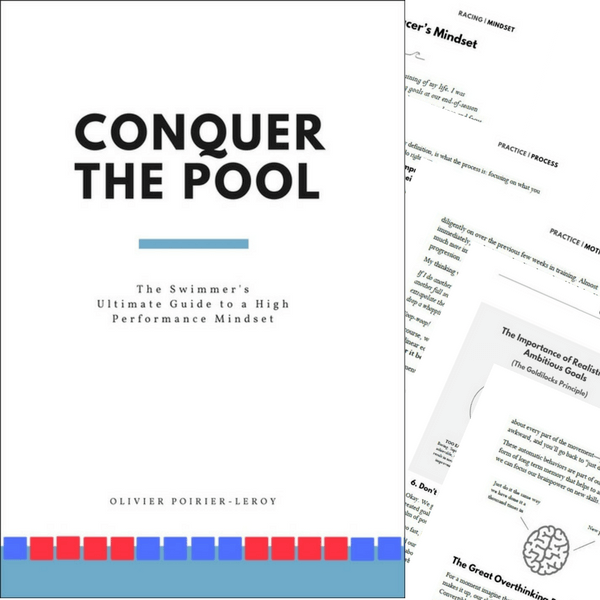 He’s also the author of the best-selling mental training workbook for competitive swimmers, Conquer the Pool: The Swimmer’s Ultimate Guide to a High-Performance Mindset.
It combines sport psychology research, worksheets, anecdotes, and examples of Olympians past and present to give swimmers everything they need to conquer the mental side of the sport.
Ready to take your mindset to the next level in the pool?
👉👉 Click here to learn more about Conquer the Pool.

